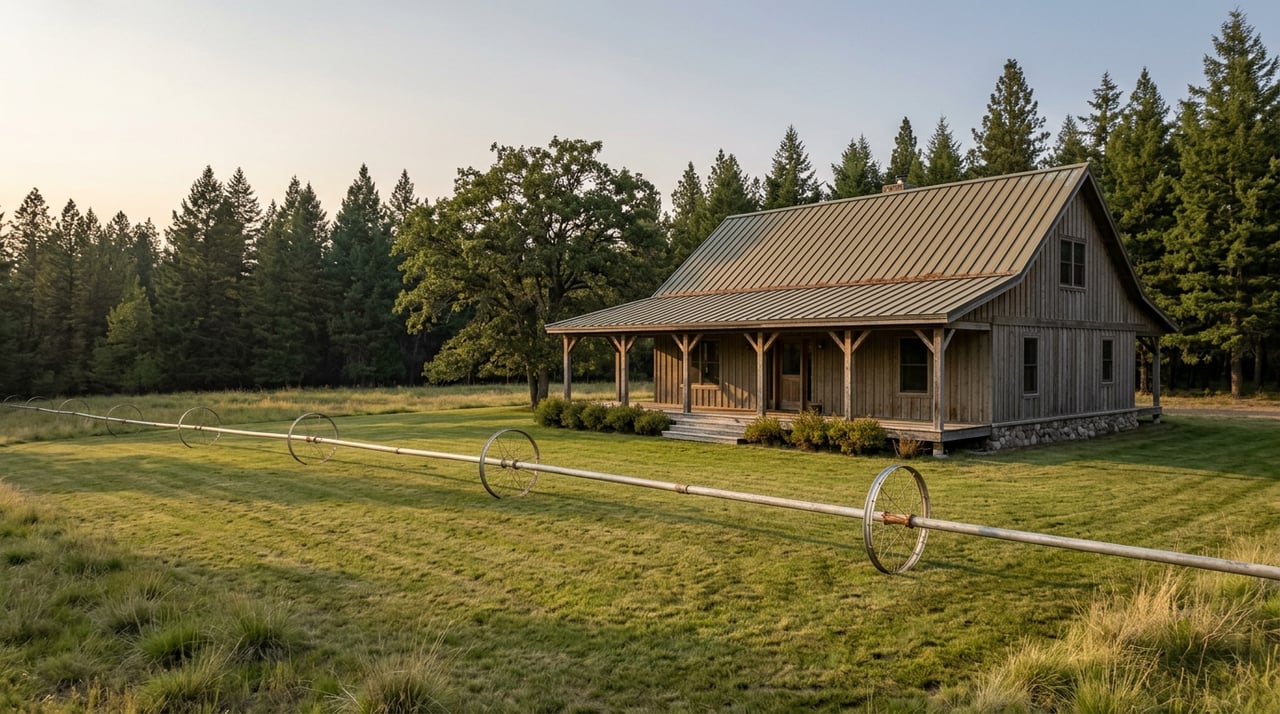
Say you close on five acres outside Grants Pass in the spring. The listing mentioned water rights, and it felt like a bonus, something extra layered onto the property rather than a bill waiting to be sent. You don't plan to run cattle or plant an orchard. You figure the water rights are just there if you ever want them.
Then, sometime the following winter, a notice arrives that isn't a bill at all. It's a lien. And the amount owed traces back to an assessment nobody billed you for, because the agency that sends those bills never knew you existed.
That agency is the Grants Pass Irrigation District, and the gap between what a listing implies and what the district actually requires is the kind of thing that only shows up once you've either lived through it or done the research most buyers skip.
The Assessment Isn't Optional, Even If You Never Touch the Water
The Grants Pass Irrigation District, known locally as GPID, has been operating since 1917, when landowners including the City of Grants Pass voted to form it. Today it serves roughly 6,000 patrons across five divisions that stretch through parts of both Josephine and Jackson counties. The district's own rules and regulations describe an annual assessment that applies to every parcel inside its boundaries, whether the owner runs a single valve or never opens one.
That's not an oversight. Oregon case law backs it up. In Miller v. Grants Pass Irrigation District, Oregon courts held that irrigation districts are quasi-municipal corporations with the power to include land within their boundaries without the consent of every landowner affected. You don't opt into GPID by signing up for water. You're in it because your parcel sits inside a line drawn more than a century ago, and that line doesn't move just because the current owner has different plans for the land.
The one adjustment available to owners is a reduction in assessed acreage based on the footprint of buildings and structures on the property. To claim it, the district requires a report from a certified Water Rights Surveyor. It's a real option, but it's one you have to pursue yourself. Nobody adjusts your bill automatically because your home sits on part of the acreage.
The County Won't Let You Split the Lot Without This District's Signature
If your plans for that acreage include dividing it, there's a second layer worth knowing before you write an offer. Oregon law, specifically ORS 92.020(6), prevents Grants Pass, Josephine County, the City of Rogue River, or Jackson County from approving a subdivision or partition inside GPID's boundaries unless the district itself has certified that the land is included in, or excluded from, its service area. In practice, that means the district has a say in your paperwork before the county ever signs off. It's not a step most buyers hear about from a listing sheet, and it's exactly the kind of local mechanic that only surfaces once you're deep into a transaction.
The District's Own Calendar
GPID runs on a fixed annual rhythm, and knowing where you land on it tells you how much time you have if something goes sideways.
| Date | What happens |
|---|---|
| Late January | Assessments processed and mailed to patrons on file |
| April 1 | Annual irrigation charges are due in full |
| April 16 | Interest begins accruing on any unpaid balance |
| Following January | District may file a Notice of Lien against the parcel |
| After that | Board may pursue foreclosure to recover charges, court costs, and attorney fees |
For 2026, the district processed and mailed assessments on January 26, with the irrigation season itself tentatively starting May 4 and a flush-out window running through at least May 18 before patrons are asked to open valves. That's a routine seasonal calendar for existing patrons who get their mail. The trouble starts when the mail doesn't reach anyone at all.
Why the First Notice Sometimes Skips the Mail
GPID has been direct about a limitation in how it tracks ownership. On its own contact information page, the district explains that it receives limited recorded information when a property inside its boundaries is sold, and that despite searching, staff often can't find updated contact details for a new owner. The responsibility to update that information falls on the property owner, not on the district or, typically, on the closing process itself.
Put those two facts together and you get the scenario at the start of this piece. A new owner closes on a parcel inside GPID's boundaries. The district doesn't have a working address or phone number for them. The annual assessment goes out anyway, mailed to whatever address is on file, which may still belong to the previous owner. Nobody pays it. Interest starts accruing April 16. By the following January, the district has grounds to file a lien under ORS 545.494, and from there it can pursue foreclosure of that lien under ORS 545.502, including recovery of its own court costs and attorney fees.
None of this requires anyone to have acted in bad faith. It requires only that a piece of paperwork nobody thought to update didn't get updated.
What the Disclosure Form Is Supposed to Catch
Oregon's Seller's Property Disclosure Statement, the standardized form written into ORS 105.464, asks sellers directly about irrigation and water rights, including whether a water rights certificate or other written evidence exists for the property. It also asks, in a separate section, whether there are any pending or existing governmental assessments against the property.
Both questions are built to surface exactly the kind of obligation GPID represents. The catch is that the form only works if the seller understands what's being asked and answers from real knowledge of the property. A seller who's owned land inside GPID's boundaries for decades and paid the bill every April without a second thought may not think to flag it as a "governmental assessment," because to them it's just part of owning that land. That's not concealment. It's the ordinary way a recurring cost becomes invisible to the person who's paid it long enough to stop noticing it.
What the Per-Acre Price Doesn't Include
Current listing data across Josephine County land marketplaces in 2026 puts per-acre asking prices for acreage somewhere in a wide band, roughly $15,000 to $30,000 depending on which tracker and which month you're looking at, with average listing prices for the county's larger parcels commonly landing well into the mid six figures. That range reflects everything from raw timberland to irrigated Applegate Valley bottomland, and it's the number most buyers anchor to when they're comparing properties.
What it doesn't reflect is the recurring cost sitting underneath a parcel that happens to fall inside GPID's boundaries. The per-acre assessment itself is a modest figure against a purchase price in the hundreds of thousands. But it's an annual, compounding, lien-eligible obligation attached to the land rather than the person who happens to be living on it, and it exists whether or not the number you paid per acre had anything to do with water.
Three Things to Confirm Before You Write an Offer
- Ask whether the parcel sits inside GPID's boundaries, and if it does, request the current assessment amount and payment history directly from the district at 200 Fruitdale Drive.
- Check the seller's disclosure statement for both the irrigation rights section and the governmental assessments section, and don't treat a blank line as a "no."
- If you plan to divide the property later, confirm in writing whether GPID considers the parcel included in or excluded from the district, since that certification affects whether the county can approve your partition at all.
FAQ
Does every property in Grants Pass belong to GPID? No. The district's boundaries are specific, spanning five divisions across parts of Grants Pass and reaching into both Josephine and Jackson counties, but plenty of land inside and around the city falls outside those lines entirely. The only way to know for certain is to ask the district directly using the parcel's Map ID number.
Can a property be excluded from the district after purchase? Exclusion is possible under Oregon irrigation district law, but it's not automatic and it's not something a new owner can assume applies just because they don't want the water. It requires a formal process through the district, and courts have already established that a district's boundary decisions don't require unanimous landowner consent.
What happens if the previous owner left an unpaid balance? Because the assessment and any resulting lien attach to the parcel rather than to the person who owned it at the time, unresolved balances are the kind of detail worth confirming before closing, not after.
If you're weighing acreage near Grants Pass and want a clearer picture of what a specific parcel actually carries with it, from irrigation district status to what the seller's disclosure does and doesn't say, Whole Heart Realty can help you ask the right questions before you're the one signing the offer. Let's talk about your next move.